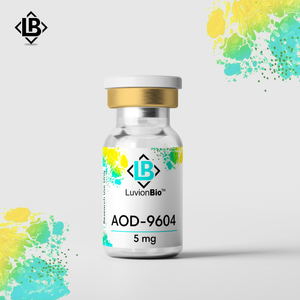
AOD-9604 | Product Description AOD-9604 | Introduction AOD-9604 is a research-use-only peptide modeled on the C-terminal fragment of human growth hormone. It is investigated within bioenergetic pathway modulation, with emphasis on lipid metabolism, mitochondrial efficiency, and cellular energy regulation under stress. Researchers probe its behavior in preclinical systems evaluating adipocyte biology and metabolic signaling. Not for diagnostic or therapeutic use. Bioenergetic modulation in lipid-metabolism models Exploration of mitochondrial efficiency under metabolic stress Assessment in preclinical weight-regulation studies AOD-9604 | Molecular Identity & Composition Name AOD-9604 Synonyms hGH fragment 176–191 analog | AOD 9604 | AOD-9604 Sequence [Cys7–Cys14] Tyr–Leu–Arg–Ile–Val–Gln–Cys–Arg–Ser–Val–Glu–Gly–Ser–Cys–Gly–Phe (YLRIVQCRSVEGSCGF) Molecular Formula C78H123N23O23S2 Molecular Weight 1815.1 g/mol CAS Number 221231-10-3 Appearance White to off-white lyophilized powder Solubility Soluble in sterile water or bacteriostatic water Purity ≥99% (HPLC) Storage Guidelines • Before Reconstitution (Lyophilized): Store at or below 0°F (–18°C). Protect from light and moisture. • After Reconstitution (Liquid): Store between 36–46°F (2–8°C). Use promptly; avoid repeated freeze–thaw cycles. • Long-Term Stability: Keep dry and frozen until ready for use. AOD-9604 | Exciting Areas of Study Lipid metabolism and adipocyte signaling Mitochondrial performance under energetic stress Cellular energy balance and AMP/ATP dynamics Preclinical body-composition research models Stress-induced metabolic pathway behavior in controlled assays LuvionBio Quality Advantage ≥99% purity | HPLC & MS validated Endotoxin <0.05 EU/mg | Third-party verified Controlled nucleation lyophilization | Stability-focused processes PhD-formulated | GMP / ISO-aligned manufacturing Shipped in Lux Cold Chain Fridge Box Category Overview | Bioenergetic Pathway Modulators Bioenergetic peptides are used in RUO studies to explore how cells generate, manage, and recover energy. These compounds interact with key metabolic pathways—especially mitochondrial ATP output and redox signaling—making them essential tools for researchers investigating energy dysfunction, oxidative stress, and cell viability under stress conditions. Modulation of ATP output in energy-restricted cellular environments Pre-clinical insights into mitochondrial performance Stress-induced metabolic pathway behavior in controlled assays Early-stage models of energy dysregulation across tissue types Insulin sensitivity & glucose regulation in cell-based assays Map links between mitochondrial health and system-level decline Assess peptide influence on cellular energy balance and efficiency Examine how metabolic flexibility contributes to tissue regeneration Research Applications Evaluate lipid-handling pathways in cellular assays Profile mitochondrial efficiency under metabolic stress Map bioenergetic signaling in preclinical models Study adipocyte behavior and energy partitioning Research Use Disclaimer This product is intended solely for laboratory research purposes. It is not suitable for human, animal, or household use. Researchers must follow institutional safety protocols. See our Terms & Conditions and our Research Compliance Disclaimers for details.